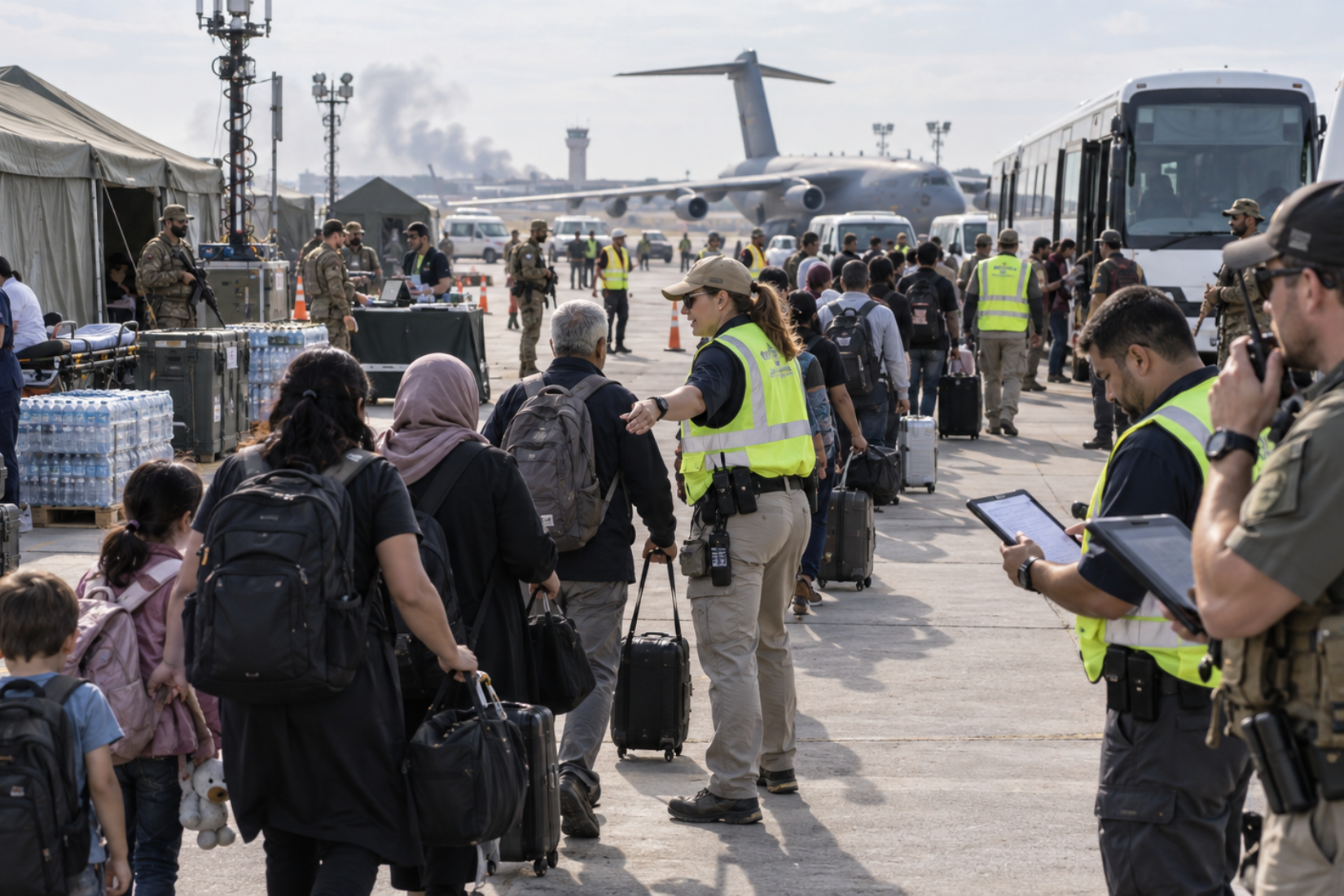
Evacuation Logistics: Why Moving People Safely Requires More Than Transportation
Evacuation missions are often viewed as transportation challenges.
Aircraft, buses, shuttles, and ground vehicles are essential, but moving people safely during a crisis requires far more than simply providing a way out. Effective evacuation logistics depends on coordination, staging, communications, medical support, security, documentation, and onward movement.
In complex emergencies, transportation is only one part of the mission.
Evacuations Begin Before Movement
Before people can be moved, they must be identified, gathered, organized, and prepared for transport.
This requires staging locations, clear communication channels, passenger accountability, security coordination, and medical screening when needed. In unstable environments, these steps must happen quickly while conditions continue to evolve.
Without strong logistics support before movement begins, delays can develop before any aircraft or vehicle is activated.
Movement Requires Coordination
Evacuation operations often involve multiple phases.
People may need to move from a high-risk area to a staging point, from staging to an airport or secure transport hub, and then to a safe destination or onward support location. Each phase requires timing, route planning, communications, and accountability.
If one phase is not aligned with the next, the entire operation can slow.
This is why evacuation logistics must connect air, ground, field support, and command coordination into one operational framework.
Safety Extends Beyond the Vehicle
In crisis environments, safe movement is not only about transportation capacity.
Evacuees may require medical support, security presence, translation assistance, temporary shelter, food, water, communications, or documentation support. Personnel managing the evacuation may also need housing, mobility, and sustainment to remain effective throughout the mission.
These support layers help protect continuity and reduce risk during complex movement operations.
Lessons from Complex Evacuation Missions
Echo1’s past support for evacuation missions in Haiti and the Middle East reflects the importance of integrated logistics in unstable environments. These operations required more than lift capacity. They required coordination across changing conditions, safe movement planning, field support, and continuity from initial assembly through onward movement.
Crisis evacuation logistics must be adaptable because conditions rarely remain fixed. Access points shift. Security conditions change. Passenger needs evolve. Transportation windows narrow. The stronger the logistics framework, the more effectively operations can adjust.
Evacuation Logistics Requires an Integrated Model
Effective evacuation support should include:
- Air and ground transportation coordination
- Secure staging and passenger accountability
- Medical and security support
- Communications across movement phases
- Temporary shelter and sustainment when needed
- Onward movement planning after initial evacuation
When these elements are integrated, agencies gain a more complete evacuation capability.
Built for Safe Movement Under Pressure
Evacuation missions are measured by more than departure. They are measured by whether people are moved safely, accounted for properly, and supported through every phase of the operation.
At Echo1 Emergency Logistics, evacuation support is structured around the full mission environment. By integrating aviation, ground mobility, communications, medical support, security, staging, and sustainment, Echo1 helps agencies manage complex evacuation operations with continuity and control.
Because in crisis response, moving people safely is not just a transportation task. It is a logistics mission.